
Professor of Medicine, University of Zaragoza
Dr. Borja del Carmelo Gracia Tello is an internist and academic director of the Unidad de Enfermedades Autoinmunes Sistémicas (Systemic Autoimmune Diseases Unit) at Hospital Clínico Universitario Lozano Blesa (Zaragoza), and Professor of Medicine at the University of Zaragoza. After completing his specialist training in Internal Medicine, he undertook a research fellowship with Prof. David Isenberg at University College London, where he gained advanced expertise in systemic autoimmune diseases and lupus. His clinical and research work focuses on microvascular involvement and connective tissue diseases, with a particular interest in systemic sclerosis, biomarkers of disease activity, and imaging-based tools to improve early diagnosis and risk stratification.
Dr. Gracia Tello has coordinated and participated in multiple national and international research projects, including studies on systemic sclerosis–associated pulmonary arterial hypertension, sarcoidosis, giant cell arteritis, and COVID-19. He is the lead inventor of a project on the digitalisation and automated analysis of nailfold capillaroscopy, developed through the GEAS (Grupo Español de Enfermedades Autoinmunes Sistémicas) of SEMI (Spanish Society of Internal Medicine), and co-author of the CAPI-Score and CAPI-Detect algorithms for quantitative videocapillaroscopy. As Chair of the Scientific Advisory Board, he provides strategic and scientific oversight for Capillaroscopy.com, ensuring that all educational content is rigorous, up-to-date, and aligned with international standards of care.
Contributed cases and studies (2)
Early SSc Cutolo Pattern: Representative Case
Complete capillaroscopy study illustrating early scleroderma-pattern microangiopathy with preserved density.
Active SSc Cutolo Pattern: Representative Case
Complete capillaroscopy study with prominent giant capillaries, hemorrhages, and moderate capillary loss.
Guides with credited review
Images in the atlas (202)
Showing 193–202 of 202 images
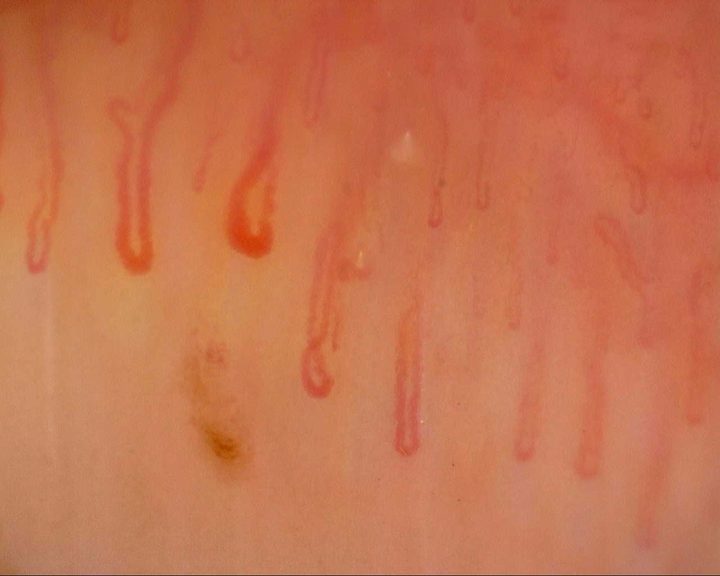
Two giant-appearing capillaries near the left-center, beside longer fine hairpin loops. A brown deposit compatible with a microhemorrhage lies below the row.
- Magnification:
- 212.92×
- Device:
- Dino-Lite Edge
- Field of view (W × H):
- ≈ 1.84 × 1.47 mm
For the subset of apices with stable automated measurements, estimated widths span approximately 16–61 µm. These are automated estimates, not manually validated measurements.
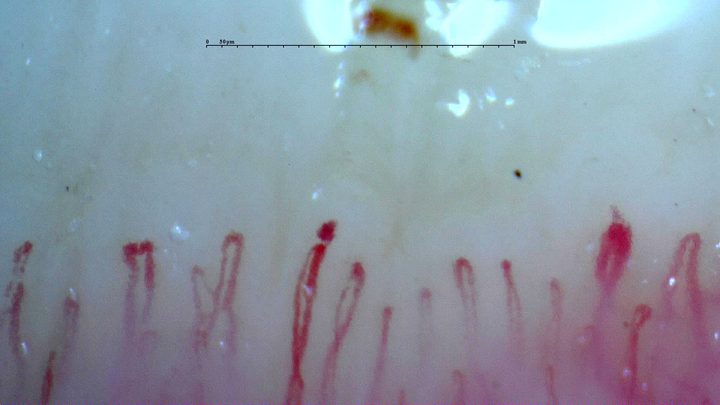
An oval giant-appearing capillary on the right and interrupted contours in some central apices. A separate brown hemorrhagic deposit lies above the row.
Recorded diagnosis: Diffuse systemic sclerosis
- Magnification:
- 250×
- Device:
- Smart G-Scope
- Field of view (W × H):
- ≈ 2.33 × 1.31 mm
For the subset of apices with stable automated measurements, estimated widths span approximately 27–53 µm. These are automated estimates, not manually validated measurements.
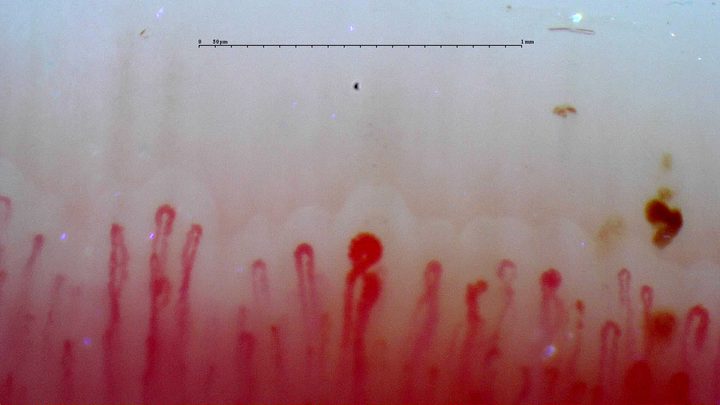
A markedly enlarged central apex and other rounded enlarged apices, beside narrower loops. Brown-red hemorrhagic deposits lie near the right edge.
- Magnification:
- 250×
- Device:
- Smart G-Scope
- Field of view (W × H):
- ≈ 2.24 × 1.26 mm
For the subset of apices with stable automated measurements, estimated widths span approximately 17–62 µm. These are automated estimates, not manually validated measurements.
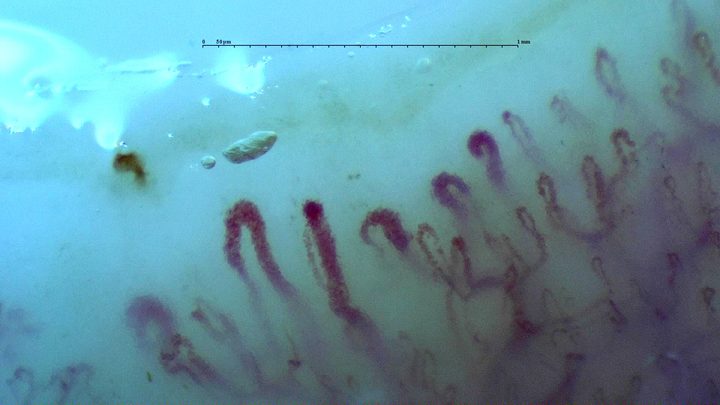
Several giant-appearing capillaries with thick rounded apices, mixed with finer and irregular loops. A brown hemorrhagic deposit lies above the left side.
- Magnification:
- 250×
- Device:
- Smart G-Scope
- Field of view (W × H):
- ≈ 2.26 × 1.27 mm
For the subset of apices with stable automated measurements, estimated widths span approximately 16–55 µm. These are automated estimates, not manually validated measurements.
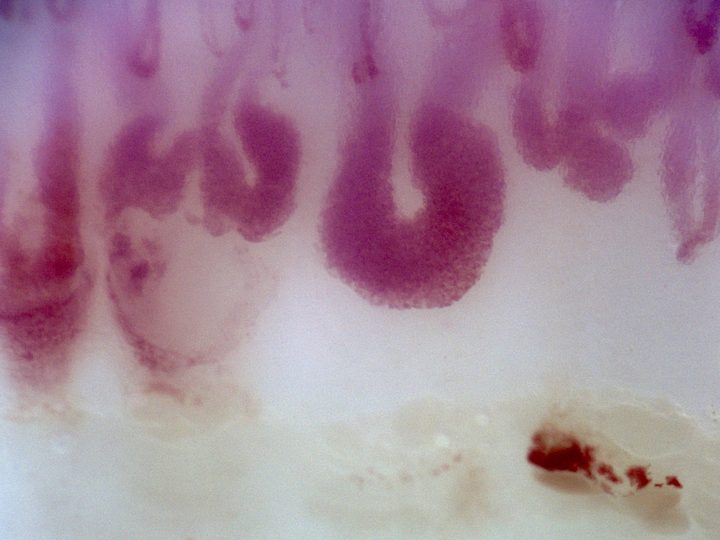
Several giant-appearing capillaries with thick rounded apices and broad limbs. Microhemorrhages lie below and to the right of the central loop.
No recorded physical calibration is available. Giant-capillary morphology is a visual assessment; the ≥50 µm diameter criterion is not confirmed.
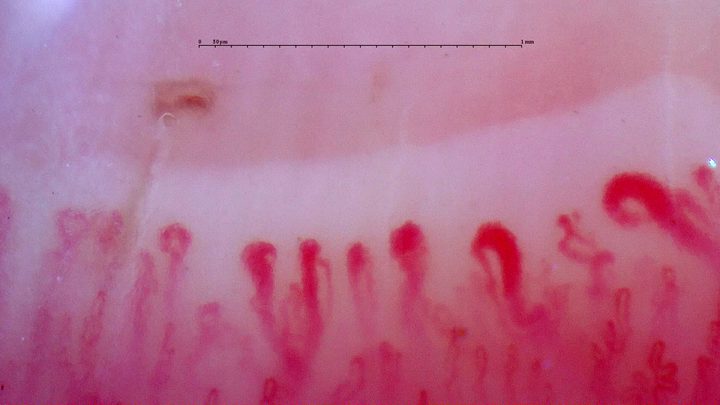
Several giant-appearing capillaries with enlarged rounded apices, including a hooked loop on the right. A brown-red hemorrhage lies above the left side.
Recorded diagnosis: Limited systemic sclerosis
- Magnification:
- 250×
- Device:
- Smart G-Scope
- Field of view (W × H):
- ≈ 2.26 × 1.27 mm
For the subset of apices with stable automated measurements, estimated widths span approximately 33–77 µm. These are automated estimates, not manually validated measurements.
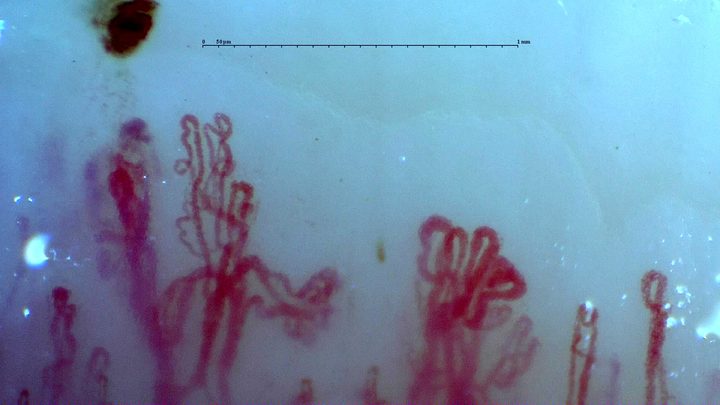
Two branching capillaries with multiple rounded apices and lateral branches. A dense dark hemorrhagic deposit lies above the left capillary.
- Magnification:
- 250×
- Device:
- Smart G-Scope
- Field of view (W × H):
- ≈ 2.30 × 1.29 mm
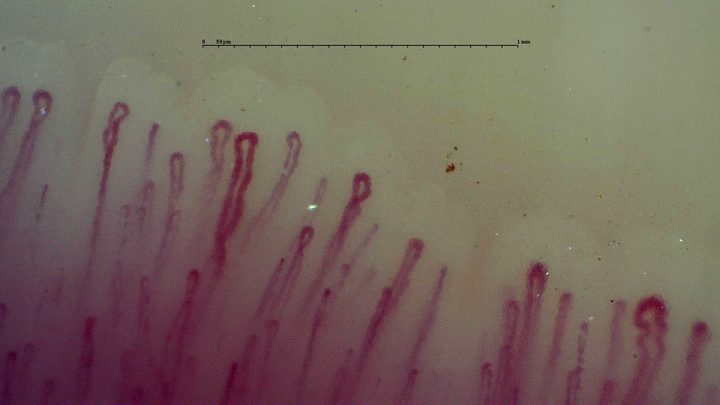
Long hairpin capillaries of different widths, with mild bends and a small oval crossed loop at the right edge.
- Magnification:
- 250×
- Device:
- Smart G-Scope
- Field of view (W × H):
- ≈ 2.27 × 1.28 mm
For the subset of apices with stable automated measurements, estimated widths span approximately 14–48 µm. These are automated estimates, not manually validated measurements.
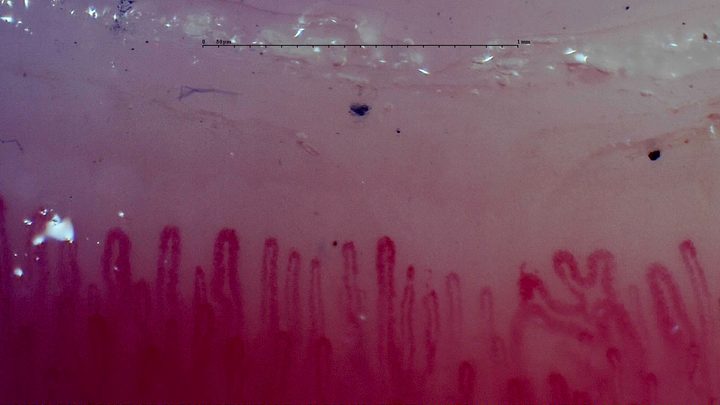
Several closely spaced curved loops at the lower right, beside simpler upright hairpin capillaries.
Recorded diagnosis: Raynaud phenomenon
- Magnification:
- 250×
- Device:
- Smart G-Scope
- Field of view (W × H):
- ≈ 2.31 × 1.30 mm
For the subset of apices with stable automated measurements, estimated widths span approximately 19–43 µm. These are automated estimates, not manually validated measurements.
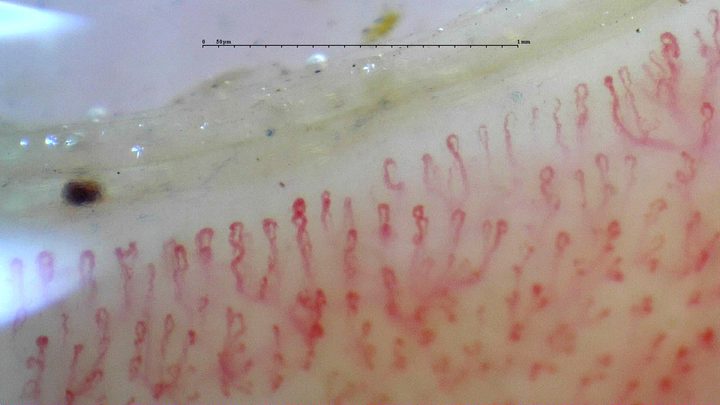
Fine hairpin capillaries with small coiled apices and possible accessory loops. Shorter vessels are visible in the deeper plane.
- Magnification:
- 250×
- Device:
- Smart G-Scope